The question
Before building anything on battery health or fire risk, the first question is simply: what open data exists, what does it actually record, and can I download it? The answers are scattered across lab sites, data portals, papers and fire-agency pages, and they rarely use the same terms.
Open Battery Data collects them in one place, checked against each source, and shows where each dataset comes from.
What’s in it
20 open datasets in four groups:
- EV field data (5): battery signals recorded in real vehicles, from 5 buses to 464 vehicles, including 21 Korean E-GMP taxis (NCM) sampled every second
- Lab cell data (12): cells cycled to end of life (NASA, CALCE, MIT / Stanford / TRI, Sandia, KIT, Stanford, Lyon, HUST), including datasets that vary the charging rate, and abuse tests that force thermal runaway (NREL Battery Failure Databank, Sandia ARC)
- EV fire incidents (2): the Korean National Fire Agency’s EV fire records and the EV FireSafe global database
- ESS fire incidents (1): EPRI’s stationary storage failure database
For each one: access (open, login, or request), country, signals (V, I, T, SOC, SOH, R and more), how it was collected and how often, whether charging is slow or fast and at what C-rate, chemistry, scale, license and source. Anything the source doesn’t state is marked n/s rather than guessed.
What the catalogue shows
- No open dataset links an EV’s own telemetry to a fire on that vehicle. Telemetry and fire records exist only separately, which is the main gap for data-driven fire risk work.
- Field data is collected in very different ways: BMS telemetry, CAN data loggers that stop while charging, or charging-station records that only see charging. That shapes what each dataset can and can’t tell you.
- Chemistry is often unstated, even for large EV datasets.
Design
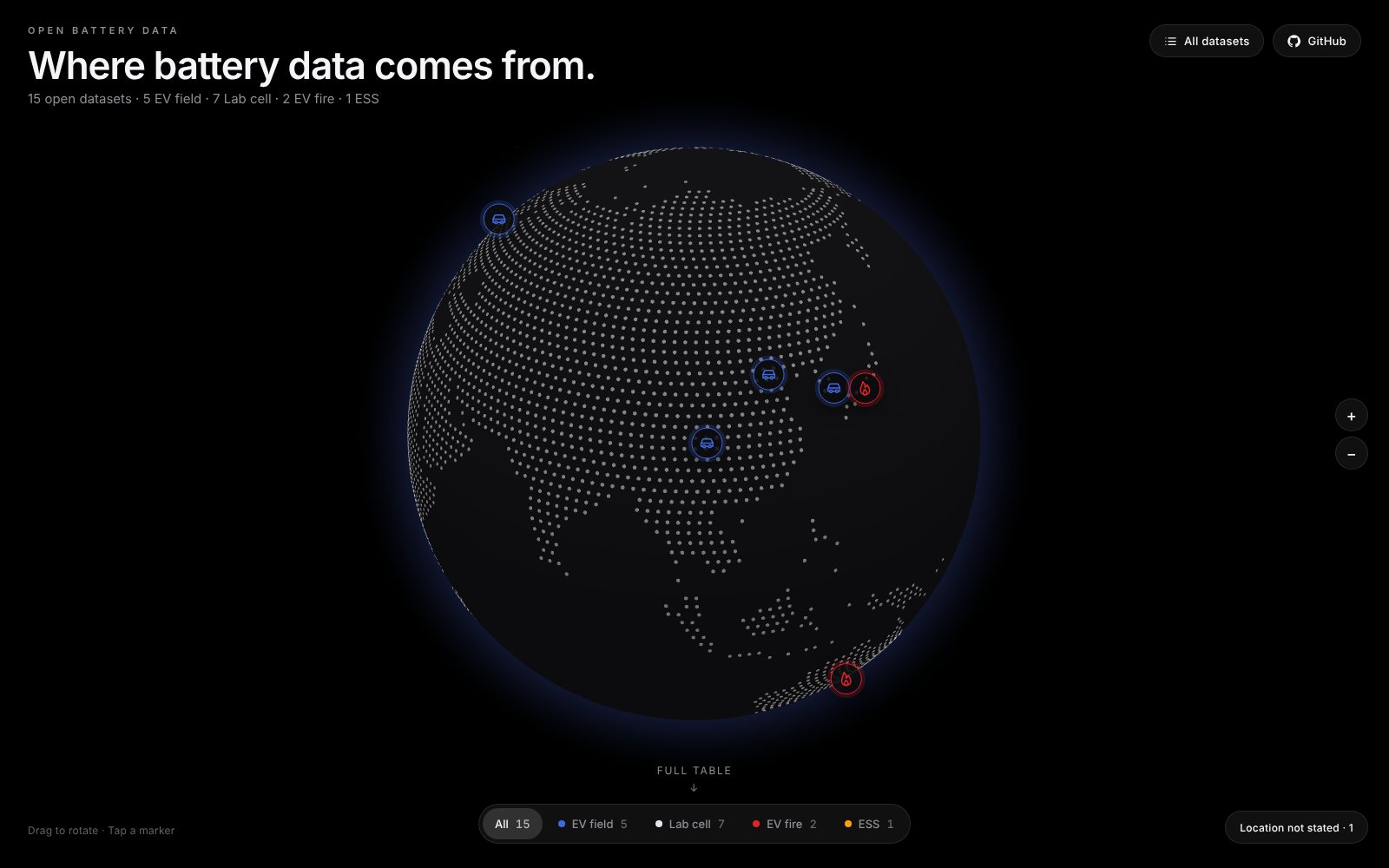
- Globe first: a dotted globe with one icon per data type (car, flask, flame, bolt). Tap a marker for a detail card; datasets from the same site are grouped.
- Tables below: the same four groups as the README, so the site and the repository never disagree.
- Black background and glass panels in the same Apple-style look as this site, with Tesla red and blue accents.
Stack
One datasets.csv is the single source of truth. A Python build script generates the README and the site’s data; a download script fetches the five datasets that have direct links. The globe uses globe.gl (three.js), hosted on GitHub Pages.
Next
- Fill in
n/svalues as datasets are opened - Add new datasets as they’re published
- Use it to pick the data for the next battery project